 Add to Chrome
 Add to Firefox
 Add to Edge
FlowErase-RL: Rethinking Concept Erasure as Reward Optimization in Flow Matching Models
May 19, 2026
Recent advances in flow matching models have significantly improved text-to-image generation quality, but also introduce growing safety risks due to the generation of harmful or undesirable content. Existing concept erasure methods are either inference-time interventions with limited effectiveness or rely on supervised fine-tuning (SFT), which requires precisely aligned data and struggles with scalability and multi-concept settings. In this paper, we propose \emph{FlowErase-RL}, the first GRPO-based framework for concept erasure in flow matching models. We reformulate concept erasure as a reward optimization problem and introduce a \textbf{dynamic dual-path reward mechanism} that jointly optimizes (i) a Concept Erasure (CE) reward to suppress target concepts and (ii) a Non-target Space (NS) reward to preserve generative fidelity. The two reward paths are adaptively balanced during training via a performance-driven switching strategy, enabling stable optimization without explicit supervision. Extensive experiments on nudity, object, and artistic style erasure demonstrate that our method achieves state-of-the-art erasure performance while maintaining strong image quality and semantic alignment. Moreover, it exhibits robust resistance to adversarial attacks and scales effectively to multi-concept scenarios. Our results establish a new paradigm for safe and controllable generation in flow matching models.

CPC-VAR:Continual Personalized and Compositional Generation in Visual Autoregressive Models
May 19, 2026Visual autoregressive (VAR) models have recently emerged as an efficient paradigm for text-to-image generation. Despite their strong generative capability, existing VAR-based personalization methods remain limited to static settings, failing to accommodate evolving user demands. In particular, sequential concept learning leads to severe catastrophic forgetting, while multi-concept synthesis often suffers from feature entanglement and attribute inconsistency. In this work, we present the first systematic study of continual personalized generation in VAR models. We identify two key challenges: (i) preserving previously learned concepts during sequential customization, and (ii) composing multiple personalized concepts in a controllable manner. To address these issues, we propose a unified framework with two core components. For continual single-concept learning, we introduce Gradient-based Concept Neuron Selection (GCNS), which identifies concept-relevant neurons and constrains only conflicting parameters across tasks, effectively mitigating forgetting without additional model expansion. For multi-concept synthesis, we propose a context-aware composition strategy that performs multi-branch feature modeling and localized cross-attention fusion guided by spatial conditions, enabling precise and disentangled concept composition. Extensive experiments demonstrate that our method significantly improves performance in long-sequence continual personalization while achieving superior results in multi-concept image synthesis compared to existing baselines. These findings highlight the potential of VAR models for scalable and controllable personalized generation.
Mistletoe: Stealthy Acceleration-Collapse Attacks on Speculative Decoding
May 13, 2026Speculative decoding has become a widely adopted technique for accelerating large language model (LLM) inference by drafting multiple candidate tokens and verifying them with a target model in parallel. Its efficiency, however, critically depends on the average accepted length $τ$, i.e., how many draft tokens survive each verification step. In this work, we identify a new mechanism-level vulnerability in model-based speculative decoding: the drafter is trained to approximate the target model distribution, but this approximation is inevitably imperfect. Such a drafter-target mismatch creates a hidden attack surface where small perturbations can preserve the target model's visible behavior while substantially reducing draft-token acceptability. We propose Mistletoe, a stealthy acceleration-collapse attack against speculative decoding. Mistletoe directly targets the acceptance mechanism of speculative decoding. It jointly optimizes a degradation objective that decreases drafter-target agreement and a semantic-preservation objective that constrains the target model's output distribution. To resolve the conflict between these objectives, we introduce a null-space projection mechanism, where degradation gradients are projected away from the local semantic-preserving direction, suppressing draft acceptance while minimizing semantic drift. Experiments on various speculative decoding systems show that Mistletoe substantially reduces average accepted length $τ$, collapses speedup, and lowers averaged token throughput, while preserving output quality and perplexity. Our work highlights that speculative decoding introduces a mechanism-level attack surface beyond existing output robustness, calling for more robust designs of LLM acceleration systems.
SPREG: Structured Plan Repair with Entropy-Guided Test-Time Intervention for Large Language Model Reasoning
Apr 20, 2026Large Language Models (LLMs) are prone to logical hallucinations and stochastic drifts during long-chain reasoning. While Classifier-Free Guidance (CFG) can improve instruction adherence, standard static implementations often cause semantic dilution and linguistic degradation. We propose SPREG (Structured Plan-guided Real-time Entropy Gating), a lightweight inference-time framework for surgical error rectification. SPREG employs an adaptive dual-threshold mechanism to monitor real-time entropy, identifying sudden ``entropy spikes'' as reliable indicators of logical failure. Upon detection, it triggers a dynamic repair by replacing uninformative null-priors with reference distributions synthesized from historical high-confidence states. By modulating guidance intensity according to structured reasoning stages (e.g., Action, Observation), SPREG steers the model back to a stable manifold without compromising fluency. Our experiments demonstrate significant gains, notably a 20.0% absolute accuracy improvement on AIME25, while effectively suppressing uncontrolled entropy drift in complex tasks.
Differential Vector Erasure: Unified Training-Free Concept Erasure for Flow Matching Models
Feb 01, 2026Text-to-image diffusion models have demonstrated remarkable capabilities in generating high-quality images, yet their tendency to reproduce undesirable concepts, such as NSFW content, copyrighted styles, or specific objects, poses growing concerns for safe and controllable deployment. While existing concept erasure approaches primarily focus on DDPM-based diffusion models and rely on costly fine-tuning, the recent emergence of flow matching models introduces a fundamentally different generative paradigm for which prior methods are not directly applicable. In this paper, we propose Differential Vector Erasure (DVE), a training-free concept erasure method specifically designed for flow matching models. Our key insight is that semantic concepts are implicitly encoded in the directional structure of the velocity field governing the generative flow. Leveraging this observation, we construct a differential vector field that characterizes the directional discrepancy between a target concept and a carefully chosen anchor concept. During inference, DVE selectively removes concept-specific components by projecting the velocity field onto the differential direction, enabling precise concept suppression without affecting irrelevant semantics. Extensive experiments on FLUX demonstrate that DVE consistently outperforms existing baselines on a wide range of concept erasure tasks, including NSFW suppression, artistic style removal, and object erasure, while preserving image quality and diversity.
ActErase: A Training-Free Paradigm for Precise Concept Erasure via Activation Patching
Jan 01, 2026Recent advances in text-to-image diffusion models have demonstrated remarkable generation capabilities, yet they raise significant concerns regarding safety, copyright, and ethical implications. Existing concept erasure methods address these risks by removing sensitive concepts from pre-trained models, but most of them rely on data-intensive and computationally expensive fine-tuning, which poses a critical limitation. To overcome these challenges, inspired by the observation that the model's activations are predominantly composed of generic concepts, with only a minimal component can represent the target concept, we propose a novel training-free method (ActErase) for efficient concept erasure. Specifically, the proposed method operates by identifying activation difference regions via prompt-pair analysis, extracting target activations and dynamically replacing input activations during forward passes. Comprehensive evaluations across three critical erasure tasks (nudity, artistic style, and object removal) demonstrates that our training-free method achieves state-of-the-art (SOTA) erasure performance, while effectively preserving the model's overall generative capability. Our approach also exhibits strong robustness against adversarial attacks, establishing a new plug-and-play paradigm for lightweight yet effective concept manipulation in diffusion models.
Closing the Safety Gap: Surgical Concept Erasure in Visual Autoregressive Models
Sep 26, 2025The rapid progress of visual autoregressive (VAR) models has brought new opportunities for text-to-image generation, but also heightened safety concerns. Existing concept erasure techniques, primarily designed for diffusion models, fail to generalize to VARs due to their next-scale token prediction paradigm. In this paper, we first propose a novel VAR Erasure framework VARE that enables stable concept erasure in VAR models by leveraging auxiliary visual tokens to reduce fine-tuning intensity. Building upon this, we introduce S-VARE, a novel and effective concept erasure method designed for VAR, which incorporates a filtered cross entropy loss to precisely identify and minimally adjust unsafe visual tokens, along with a preservation loss to maintain semantic fidelity, addressing the issues such as language drift and reduced diversity introduce by na\"ive fine-tuning. Extensive experiments demonstrate that our approach achieves surgical concept erasure while preserving generation quality, thereby closing the safety gap in autoregressive text-to-image generation by earlier methods.
Temporal Saliency-Guided Distillation: A Scalable Framework for Distilling Video Datasets
May 27, 2025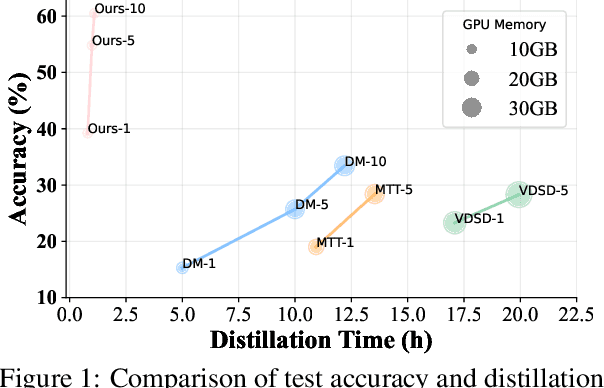

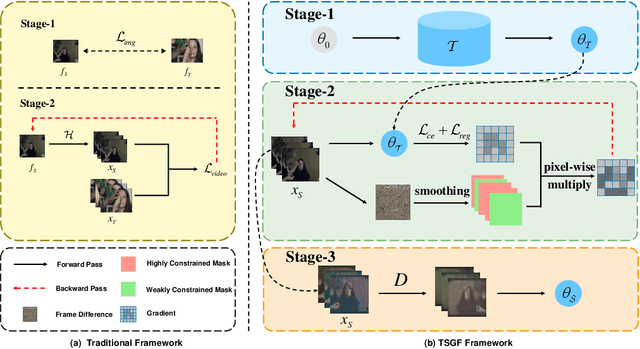
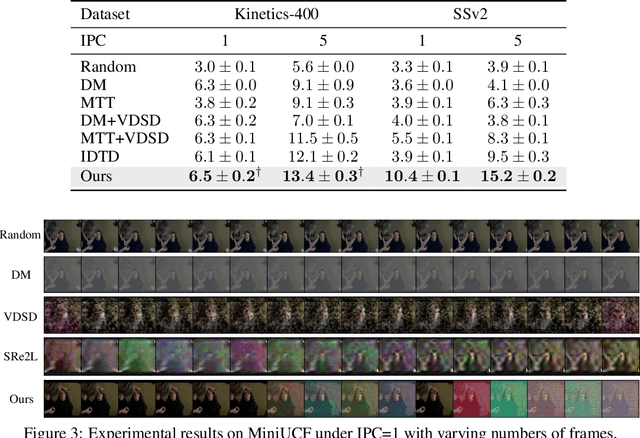
Dataset distillation (DD) has emerged as a powerful paradigm for dataset compression, enabling the synthesis of compact surrogate datasets that approximate the training utility of large-scale ones. While significant progress has been achieved in distilling image datasets, extending DD to the video domain remains challenging due to the high dimensionality and temporal complexity inherent in video data. Existing video distillation (VD) methods often suffer from excessive computational costs and struggle to preserve temporal dynamics, as na\"ive extensions of image-based approaches typically lead to degraded performance. In this paper, we propose a novel uni-level video dataset distillation framework that directly optimizes synthetic videos with respect to a pre-trained model. To address temporal redundancy and enhance motion preservation, we introduce a temporal saliency-guided filtering mechanism that leverages inter-frame differences to guide the distillation process, encouraging the retention of informative temporal cues while suppressing frame-level redundancy. Extensive experiments on standard video benchmarks demonstrate that our method achieves state-of-the-art performance, bridging the gap between real and distilled video data and offering a scalable solution for video dataset compression.
DD-Ranking: Rethinking the Evaluation of Dataset Distillation
May 19, 2025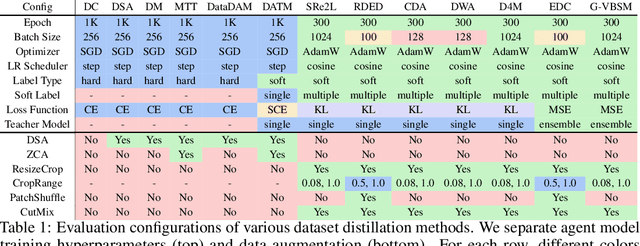
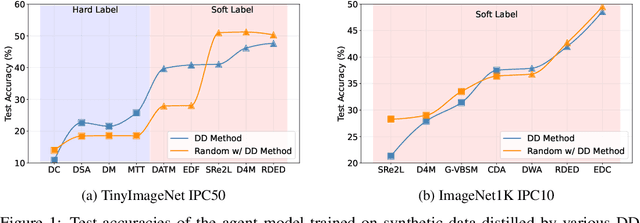
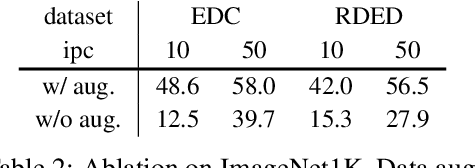
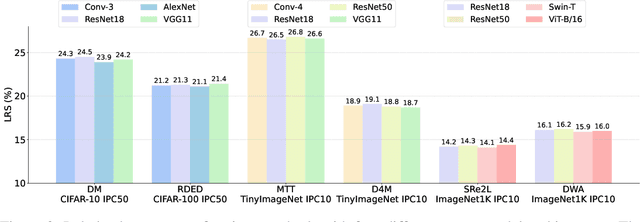
In recent years, dataset distillation has provided a reliable solution for data compression, where models trained on the resulting smaller synthetic datasets achieve performance comparable to those trained on the original datasets. To further improve the performance of synthetic datasets, various training pipelines and optimization objectives have been proposed, greatly advancing the field of dataset distillation. Recent decoupled dataset distillation methods introduce soft labels and stronger data augmentation during the post-evaluation phase and scale dataset distillation up to larger datasets (e.g., ImageNet-1K). However, this raises a question: Is accuracy still a reliable metric to fairly evaluate dataset distillation methods? Our empirical findings suggest that the performance improvements of these methods often stem from additional techniques rather than the inherent quality of the images themselves, with even randomly sampled images achieving superior results. Such misaligned evaluation settings severely hinder the development of DD. Therefore, we propose DD-Ranking, a unified evaluation framework, along with new general evaluation metrics to uncover the true performance improvements achieved by different methods. By refocusing on the actual information enhancement of distilled datasets, DD-Ranking provides a more comprehensive and fair evaluation standard for future research advancements.
Efficient Dataset Distillation via Diffusion-Driven Patch Selection for Improved Generalization
Dec 13, 2024

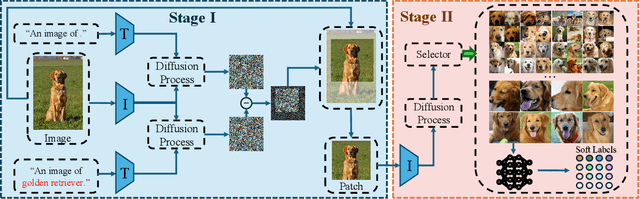

Dataset distillation offers an efficient way to reduce memory and computational costs by optimizing a smaller dataset with performance comparable to the full-scale original. However, for large datasets and complex deep networks (e.g., ImageNet-1K with ResNet-101), the extensive optimization space limits performance, reducing its practicality. Recent approaches employ pre-trained diffusion models to generate informative images directly, avoiding pixel-level optimization and achieving notable results. However, these methods often face challenges due to distribution shifts between pre-trained models and target datasets, along with the need for multiple distillation steps across varying settings. To address these issues, we propose a novel framework orthogonal to existing diffusion-based distillation methods, leveraging diffusion models for selection rather than generation. Our method starts by predicting noise generated by the diffusion model based on input images and text prompts (with or without label text), then calculates the corresponding loss for each pair. With the loss differences, we identify distinctive regions of the original images. Additionally, we perform intra-class clustering and ranking on selected patches to maintain diversity constraints. This streamlined framework enables a single-step distillation process, and extensive experiments demonstrate that our approach outperforms state-of-the-art methods across various metrics.